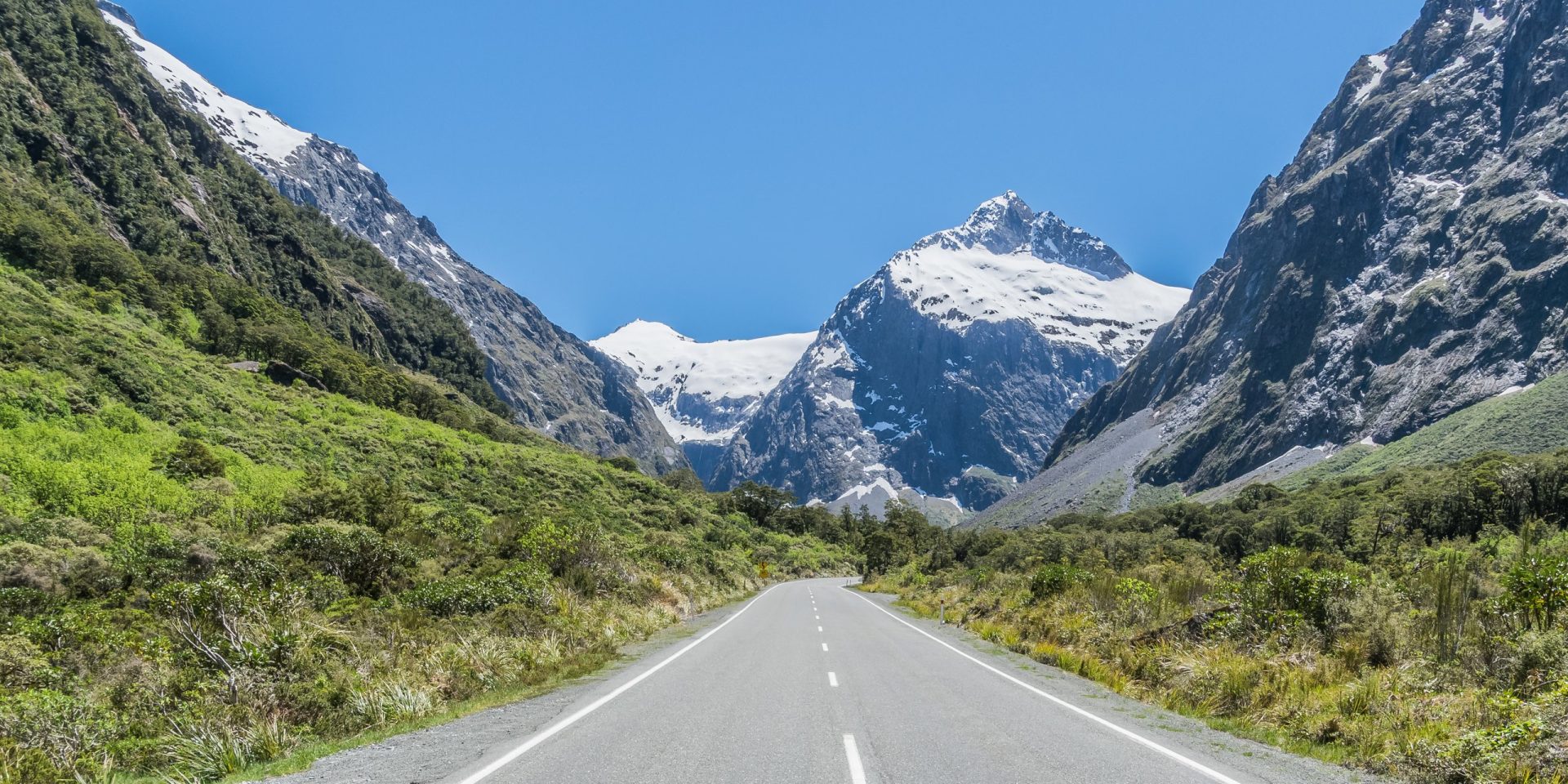
The Milford Road
Today, the journey from Te Anau to Milford Sound Piopiotahi is regarded as one of the world’s great scenic drives. Visitors leave the shores of Lake Te Anau and travel through the vast Eglinton Valley, past ancient beech forest and mirror-like lakes, beneath towering mountains and finally through the Homer Tunnel before descending dramatically into Milford Sound.
It is easy to become absorbed by the scenery. But behind the Milford Road is an extraordinary story of exploration, ambition, hardship and sheer determination.
Long before State Highway 94 existed, the journey into this part of Fiordland was considerably more difficult – and the story of the road we travel today stretches back centuries.
Long Before the Milford Road
The first routes through this landscape were not European ones.
Maori knew and travelled through Fiordland long before European exploration. Two principal routes linked the Fiordland coast with the rest of Te Waipounamu. One followed the coast, while an inland route crossed what Europeans would later call the Milford Track, travelling over Omanui/Mackinnon Pass and down the Clinton Valley to Te Ana-au. Greenstone, food and other resources were carried through this formidable landscape.
Historical accounts also record that the route across Mackinnon Pass was known to Maori and used by greenstone hunters travelling between the coast and Lake Te Anau.
European knowledge of the region developed much later. One of the most colourful characters in that story was Donald Sutherland.
Born in Wick, Scotland, Sutherland had already lived an adventurous life as a sailor, gold miner, sealer and soldier before arriving at Milford Sound in the late 1870s. He eventually made Milford his home.
Quintin Mackinnon Finds a Way Through
In 1888, surveyor Quintin Mackinnon was commissioned to find a route up the Clinton Valley and determine whether the mountains at its head could be crossed.
The conditions were brutal. After establishing a camp near what is now Glade House, Mackinnon and Ernest Mitchell pushed into the mountains through almost continuous rain.
On 16 October 1888, they reached the saddle that now bears Mackinnon’s name. Just four days later, Mackinnon led the first party across the route between Milford and Lake Te Anau.
The Milford Track was born. But another enormous problem remained. Walking across Fiordland was one thing. Building a road through it was something else entirely.
The Mountain Standing in the Way
In 1889, explorers William Henry Homer and George Barber reached a saddle high above the Hollyford Valley. Ahead of them stood an enormous wall of granite separating the Hollyford and Cleddau valleys.
Homer realised that a road to Milford would ultimately require something extraordinarily ambitious for the time: a tunnel straight through the mountain.
His idea was investigated in 1890. A government engineer estimated that a small tunnel through Homer Saddle might cost around GBP 2,000. By the time the tunnel was actually constructed more than half a century later, the cost had exceeded half a million pounds.
Homer never lived to see his idea become reality. He died in 1894. For decades, the proposal remained little more than an ambitious dream. Then came the Great Depression.
Building a Road Through the Wilderness
Construction of the Milford Road began from Te Anau in 1929.
With unemployment soaring during the Depression, public works projects provided desperately needed employment. Around 200 men worked on the early road using equipment that seems almost unbelievable today: picks, shovels, sledgehammers, handsaws and wooden wheelbarrows.
There were no modern excavators carving effortlessly through the landscape. The road was pushed kilometre by kilometre into Fiordland.
Workers’ camps followed it into the wilderness, including camps at Cascade Creek, Marian and Homer. Some men lived under canvas, often with their wives and families joining them in an environment that could be beautiful one moment and brutally unforgiving the next.
By 1934 the road had reached The Divide. Then the workers faced the obstacle William Homer had identified nearly half a century earlier: the mountain.
Five Men, Pickaxes and a Mountain
Work on the Homer Tunnel began in 1935. Initially, the tunnelling crew reportedly consisted of only five men.
Their task was extraordinary: start digging through more than a kilometre of solid Fiordland rock.
The tunnel was being driven downhill towards Milford, creating another miserable complication. Meltwater poured through fractures in the mountain and accumulated where the men were trying to work. Historical accounts describe approximately 8,000 gallons of freezing snowmelt entering the tunnel every hour, requiring pumps to operate continuously while the men worked around them.
Then there were the avalanches.
When the Mountain Fought Back
The Milford Road workers weren’t simply building in difficult country. At times, the country seemed determined to destroy what they had built.
Avalanches, floods, snow and rockfall repeatedly damaged roadworks, bridges and tunnel entrances. Workers were killed.
One particularly extraordinary incident occurred in 1934, when an avalanche engulfed five men along with their tents and equipment. Remarkably, the men survived – although accounts say the force of the avalanche tore clothing from their bodies.
In 1936 another avalanche struck a workers’ hut, killing one man and injuring others. The following year another high-speed avalanche killed two more men.
Even engineering designed specifically to withstand the mountains wasn’t always enough. In 1945, an avalanche destroyed a supposedly ‘avalanche-proof’ concrete structure protecting the tunnel entrance. They didn’t rebuild it.
Finally, Light at the End of the Tunnel
Despite the conditions, the workers eventually broke through the mountain in 1940. But there was still a long way to go.
The Second World War created severe labour shortages and work effectively stopped. Construction did not resume properly until 1951, when machinery was used to enlarge and finish the tunnel.
The Homer Tunnel was finally completed in the early 1950s, creating the road connection that William Homer had imagined more than 60 years earlier.
The tunnel stretches approximately 1.2 kilometres through the Darran Mountains, descending towards Milford at roughly a 1-in-10 gradient.
For the first time, ordinary motorists could drive all the way from Te Anau into Milford Sound. It fundamentally changed tourism in Fiordland.
The Road Still Wasn’t Finished
Even after the tunnel opened, the Milford Road was very different from the highway visitors know today. Large sections remained gravel for decades, and winter travel was severely restricted because of snow and avalanche danger.
By the late 1970s, local tourism and fishing interests had successfully pushed for the road to remain open throughout the year.
Then tragedy struck again. In 1983, an avalanche killed a Milford Road maintenance supervisor. The accident helped lead to the development of the sophisticated avalanche monitoring and control programme that continues to protect travellers on the Milford Road today.
The road was progressively improved and sealed, with the final sealing and widening completed in 1992.
Look Closely and the Old Milford Road Is Still There
Perhaps one of the loveliest parts of the story is that the people who built the Milford Road haven’t completely disappeared from the landscape.
Historical reporting records that around places where the old road camps once stood, small traces of their lives survived long after the workers left. Near The Cinques, roadmen planted raspberry canes. Elsewhere, apparently untouched bush conceals the foundations of former homes.
Thousands of visitors drive past these places without ever knowing they are there. It is a reminder that the Milford Road wasn’t simply an engineering project. For years, it was someone’s home.
Men worked here. Women joined their husbands here. Children were raised in isolated camps surrounded by mountains, forest, rain and snow. Entire little communities existed along a road that hadn’t even been finished yet.
More Than Just the Road to Milford Sound
Today, State Highway 94 is the only road into Milford Sound Piopiotahi and one of New Zealand’s great scenic journeys.
From Fiordland Lakeview Motel & Apartments in Te Anau, the road carries travellers from the edge of Lake Te Anau into an increasingly wild landscape – through the Eglinton Valley, past Mirror Lakes, through ancient beech forest, beyond The Divide and eventually into the mountains surrounding the Homer Tunnel.
When the traffic light turns green and you begin driving through that dark tunnel, it is worth remembering what you’re actually travelling through: nearly 1.2 kilometres of mountain, a route first imagined in the nineteenth century, a tunnel begun by Depression-era workers with remarkably basic tools, and a road repeatedly attacked by floods, snow and avalanches.
The Milford Road isn’t simply the journey to Milford. It is part of the Milford experience itself.
Planning Your Milford Sound Journey from Te Anau?
Fiordland Lakeview Motel & Apartments sits on the lakefront in Te Anau, making it an ideal base before or after exploring the Milford Road and Milford Sound Piopiotahi.
Rather than rushing the journey from further afield, stay in Te Anau and give yourself time to experience the road properly. Some of Fiordland’s greatest scenery – and some of its most remarkable history – lies between Te Anau and Milford.
Photo: Krzysztof Golik, CC BY-SA 4.0, via Wikimedia Commons.